

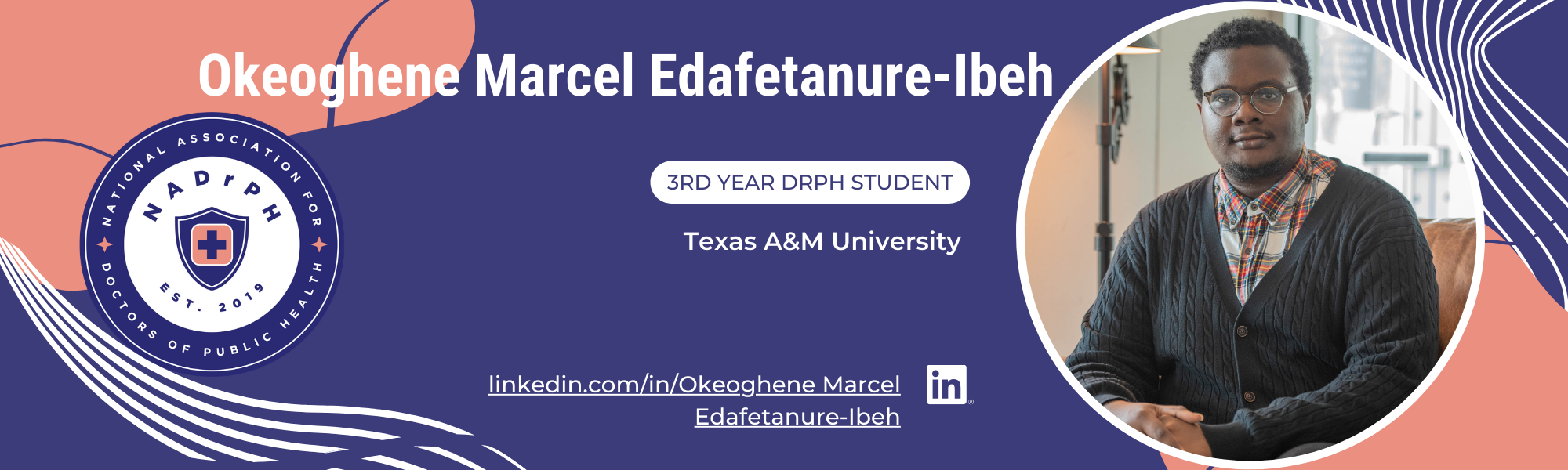
Okeoghene Marcel Edafetanure-Ibeh
Tell us about yourself.
My name is Okeoghene Marcel Edafetanure-Ibeh, I am Originally from Delta State, Nigeria, but I currently reside in Texas and I am a Doctor of Public Health (DrPH) candidate at Texas A&M University, where I also earned my Master of Public Health degree. My academic foundation began with a Bachelor’s in Medical Laboratory Science with a concentration in microbiology from Babcock University, Nigeria. Over time, I have combined this technical expertise with training in environmental and occupational health to focus on tackling pressing public health challenges. Coming from Nigeria and being one of the first in my family to get an advanced degree, my journey has been shaped by resilience, a deep commitment to service, and a passion for advancing global health equity.
Why did you pursue a DrPH?
I pursued a DrPH because I wanted to do more than conduct research, I wanted to turn knowledge into action. My training in microbiology and public health showed me the challenges of issues like antibiotic resistance and health disparities. But I also saw that solving these problems takes more than science. It requires leadership, systems thinking, and the ability to connect research to real-world solutions. The DrPH gives me those tools. It prepares me to design programs, shape policy, and work directly with communities. For me, this degree is about bridging science, practice, and leadership to make health solutions more equitable and impactful, both in the U.S. and globally.
What are you currently excited about in your job?
Right now, I’m most excited about the opportunity to teach and develop my skills as an educator, I am excited about the opportunities to develop my leadership skills and do research on topics I am passionate about, I’m also excited that I get to eventually translate my research into real-world impact. My work on antibiotic resistance and medication adherence has the potential to move into the program design stage, where I can develop education initiatives that directly help students make safer health decisions. I’m also energized by the chance to collaborate with peers, faculty, and community partners. Whether it’s building educational tools, teaching, mentoring students, or engaging in policy discussions, I enjoy seeing how our collective efforts can improve health outcomes. What excites me most is knowing that the work I do today has the potential to shape stronger, more equitable health systems for the future.
If you could write a book about your life, what would the title be and why?
If I could write a book about my life, the title would be “Against All Odds.” This reflects my journey of overcoming all of challenges that I have been faced with by the help of God. Despite financial, cultural, and personal obstacles, I have stayed focused on my goals and remained committed to making an impact. The title captures both the resilience that has carried me forward and the belief that barriers can be transformed into opportunities to create lasting change.
What is something interesting about you that we should know?
Something interesting about me is that I’m not only passionate about public health, but I also love photography and videography. Capturing special moments through a camera lens is my creative outlet outside of research and leadership.
