

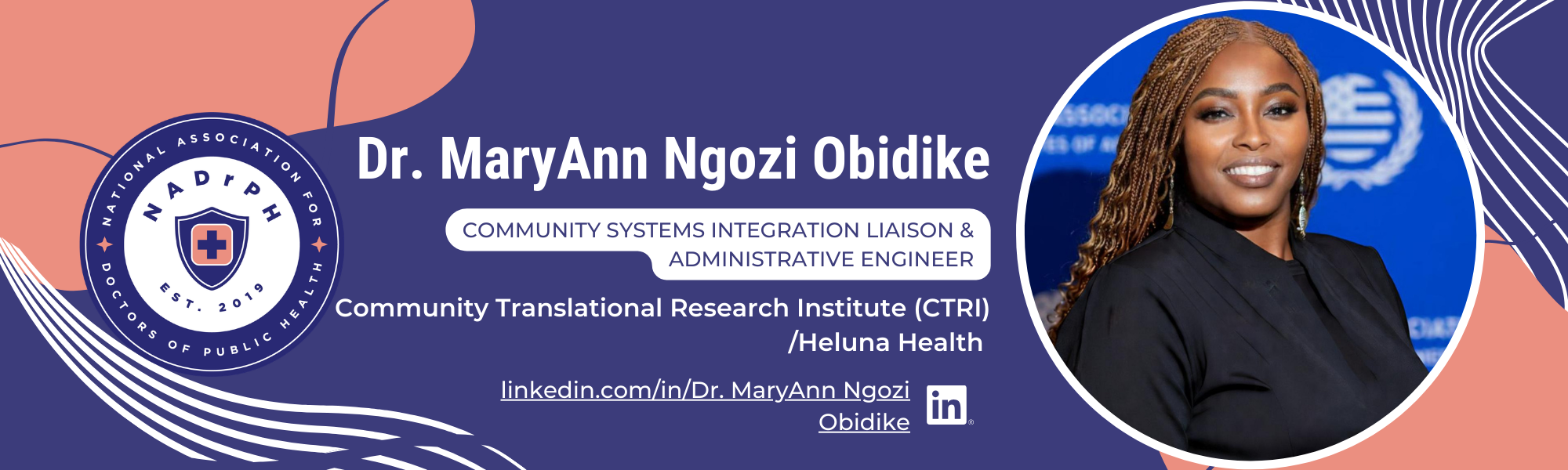
Dr. MaryAnn Ngozi Obidike
Tell us about yourself.
I am a globally minded public health strategist, systems thinker, and advocate dedicated to advancing equity, strengthening community resilience, and translating research into sustainable action. With more than fifteen years of professional experience across Africa, Europe, and the United States, my work bridges global program leadership, health systems design, and academic innovation. My professional journey spans directing USAID- and DFID-funded programs with ActionAid International and Catholic Relief Services, where I led multi-state initiatives that institutionalized gender-responsive HIV programming, strengthened child protection systems, and empowered vulnerable households through social and economic development. Among my proudest accomplishments, I developed and disseminated over 25 state-specific technical policy documents, reactivated child protection committees across five states, and trained more than 350 community volunteers to expand HIV prevention and care coverage . I also co-led the “End Violence Against Children” national campaign across Nigeria, working closely with state ministries and local councils to enact protective laws and community education programs. In the United States, I have contributed to systems transformation efforts through the Community Translational Research Institute (CTRI) and Heluna Health, leading redesign efforts under the PATH CITED Program (CalAIM ECM/Community Supports). My work includes enhancing referral processes, strengthening care coordination workflows, and leading strategic partnership development to improve service delivery and patient outcomes. At El Sol Neighborhood Educational Center, I drove grant analysis and compliance, successfully identifying new funding opportunities and streamlining application processes that improved program sustainability. Academically, I hold a Master of Science in Health Management Psychology and am completing a Doctor of Public Health (DrPH) at Claremont Graduate University (CGU). I have also earned multiple professional credentials, including the CGU Certificate in Foundational Public Health, the Population Health Systems Engineering and Integration Certification, and two advanced teaching credentials—the Inclusive Excellence in College . My research focuses on trauma-responsive prevention models, early childhood substance use risk, and systems-level approaches to health equity, blending evidence-based science with practical innovation. I have authored and presented more than ten abstracts at national and international conferences—including the International AIDS Conference, HIV Research for Prevention (HIVR4P), and the American Public Health Association (APHA) Annual Meeting & Expo—and have led the development of multiple technical and policy documents on child protection, health communication, and systems strengthening. As an APHA Abstract Reviewer for both the Community Health Planning and Policy Development (CHPPD) and Public Health Education and Health Promotion (PHEHP) Sections, I actively contribute to shaping evidence-informed public health practice. My professional affiliations span both nonprofit and for-profit sectors, and I bring extensive expertise in social and economic development, systems strengthening, health communication, advocacy and policy, HIV & AIDS programming, human rights, sexual and reproductive health, and community-based initiatives. I have an outstanding record of working effectively with diverse populations across all age groups—regardless of race, ethnicity, color, or gender—building bridges across differences to achieve equitable outcomes. I have also served as a Board Member for several reputable nonprofit organizations and foundations in both Nigeria and the United States, contributing strategic guidance, technical expertise, and community leadership. My global impact includes training over 150 women in auto mechanics through the Lady Mechanic Initiative, achieving over 80% job placement with companies like Toyota and Mitsubishi—a powerful example of transforming gender equity into sustainable economic empowerment. Beyond my technical expertise, I am passionate about mentorship and community-led health solutions. I integrate systems theory and mindfulness approaches to enhance well-being and cultivate collaboration for sustainable impact. An active member of the United Nations Association of the USA (UNA-USA), I currently serve as Co-Chair of the UNA Women Affinity Group and as a Board Member of the UNA-USA Pomona Valley Chapter, after serving two years as the group’s Secretary. I am also a United to Beat Malaria Advocacy Champion, continuing to lend my voice to global health efforts that protect and empower communities worldwide. Recognized by the United Nations Foundation, American Public Health Association, and Intercollegiate Feminist Center, I remain deeply committed to mentoring the next generation of public health leaders and advancing systems that allow every community to thrive. My work reflects a lifelong dedication to bridging evidence, equity, and empathy—building a healthier, more just, and resilient world for all.
As an experienced technical assistance (TTA) provider, I have directed numerous TTA centers such as the National Reentry Resource Center and Children Exposed to Violence TTA Center, both funded by the U.S. Department of Justice. Currently, I serve as Director of the Reimagining Community Safety project and as a subject matter expert for the Comprehensive Opioid, Stimulant, and Substance Use Program (COSSUP), also funded by the U.S. Department of Justice. I have developed and published organizational assessments and evidence-based practice resources for community-based and justice organizations to support the identification of barriers to effective practice implementation and to help build strategic plans for system change. I have conducted Capitol Hill briefings for the U.S. Congress to discuss the application of criminal justice and public health policy reforms in real-world settings.
In addition, I am an Adjunct Professor at Bovard College at the University of Southern California, where I teach adolescent development and behavior, criminal epidemiology, organizational development, and system thinking. Personally - I absolutely love living in Utah, where the beautiful outdoors are always within reach. Hiking in the mountains with my labradoodle, Mac, and golden retriever, Rip, is one of my favorite ways to spend time. My husband and I share a passion for adventure and enjoy exploring nature, cooking together, and cheering on our favorite sports teams. Above all, we cherish our family time with our son, Zach, making memories and enjoying everything our wonderful community has to offer.
Why did you pursue a DrPH?
I pursued a Doctor of Public Health (DrPH) to strengthen my ability to lead evidence-driven change in complex health systems. The program allows me to merge theory, leadership, and real-world practice—equipping me to influence policy, improve program design, and drive systemic solutions to health inequities. Through my doctoral training, I’ve refined my leadership philosophy: integrating science, compassion, and collaboration to foster sustainable, population-level change.
What are you currently excited about in your job?
I’m energized by the opportunity to help redesign CTRI’s systems engineering structure—a transformative effort to strengthen integration, efficiency, and impact across our growing portfolio of community-based initiatives. This role enables me to apply my expertise in strategic planning, project management, and policy design to advance tiered models of support for student and community well-being across school districts. Equally exciting is my ongoing commitment to mentoring the next generation of public health professionals—helping students and early-career practitioners build capacity, develop leadership competencies, and embrace systems thinking in practice. Collaborating with cross-sector partners, I’m deeply inspired by how shared vision and community engagement can turn complex challenges into sustainable, people-centered solutions. Every project reminds me that meaningful change begins with relationships and intentional design—two principles that continue to shape my passion for public health innovation and collective transformation.
If you could write a book about your life, what would the title be and why?
Title: Becoming Whole: Lessons from the Margins Because my journey has been one of restoration, courage, and purpose—finding wholeness through service, resilience, and faith while navigating diverse cultures, challenges, and transformations. My story is a testament to how purpose can emerge from adversity, and how a life dedicated to humanity can redefine what it means to lead, heal, and thrive.
What is something interesting about you that we should know?
As a Randall Lewis Health Policy Fellow, I am currently placed with BreastfeedLA, where I lead advocacy and research initiatives that strengthen statewide lactation policy and maternal health equity. In this role, I support the development of policy toolkits, legislative tracking systems, and community education resources designed to promote equitable access to breastfeeding support for working parents and students across California. My fellowship experience has allowed me to merge systems-level analysis with policy implementation—bridging gaps between research, advocacy, and practice. Working alongside partners in public health and legislative networks, I continue to apply a justice-oriented framework that uplifts maternal and child health as essential components of social equity. .
